Author Archives: kjdtennis

Unknown's avatar

About kjdtennis

Husband and caregiver

We Are Back!

It has been more than 2 years since we posted anything here. KJ became ill with kidney failure in November, 2020 and put on bed rest. A diagnosis was confirmed March, 2021, ANCA Vasculitis, and our world came to a halt. That made us “proud” that both of us were now owners of an autoimmune disease.

After a year of chemo and steroid treatments and a year of rehab, life is finally getting close to normal. Or at least a new normal.

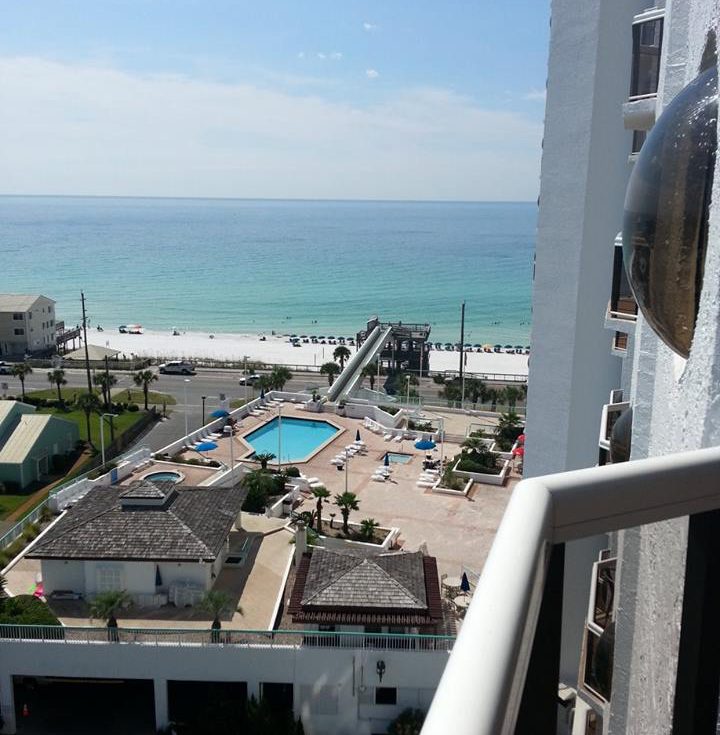
We are healthy and strong enough to travel to our condo in Florida again so look for more comments about traveling with a handicapped family member in the near future.

Recent Encounters

A couple of recent encounters generated some thoughts I wanted to share.  Both of these go the question of who should have handicap parking privileges.

Vans Only

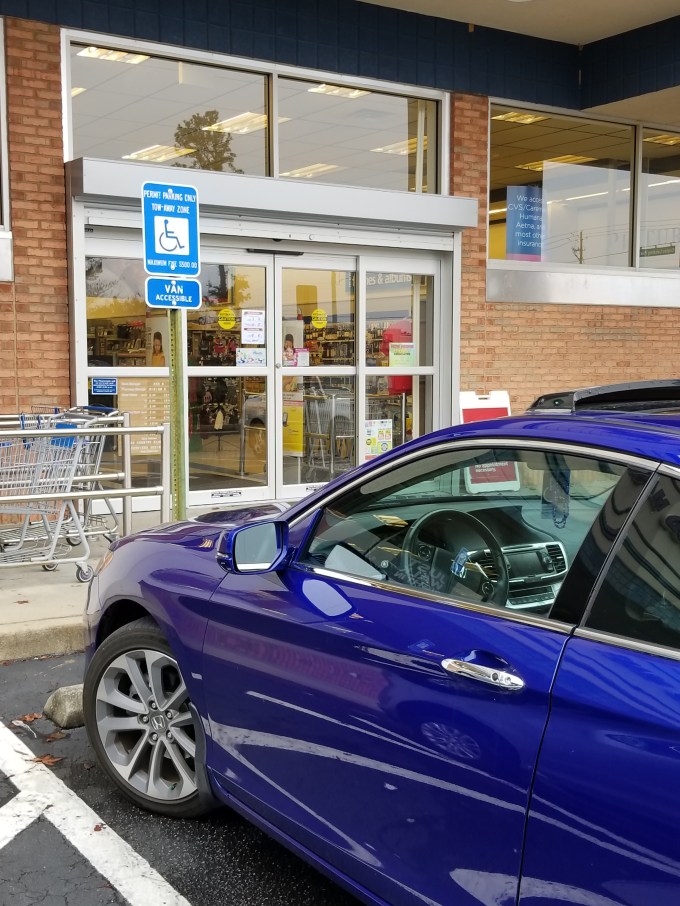
The first was a car parked in a handicap space at the front door of a store we were visiting.     The car had a legitimate placard hanging from the rear-view mirror.  The space was identified on the sign as “Van Accessible”.  Note the sign doesn’t say “Van Access Only” which I have seen in a few places.  This space was one of several open handicap spaces in front of the store but the only one that accommodated ramp deployment on the passenger side.

Technically the driver of the car is breaking no laws.  To avoid impact to us, the other driver should have parked in a space not set aside for vans.  I don’t want to be cynical but the idea of trusting humans to read signs and grasp their full implication is a non-starter.  This person would have to be generally courteous and also aware of issues facing handicap families like ours.  That is too much to expect.

I don’t have a good solution for this problem other than to put signs that say “Van Access Only”.  That’s not a 100% solution either without strict enforcement which is never going to happen.


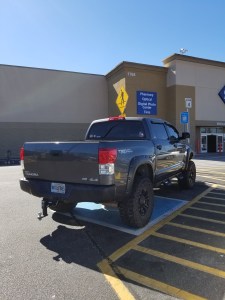
The second encounter takes me back to the ease with which handicap privileges are approved.  Take a look at this hog of a pickup jacked up with big tires. Hog Truck

Note it has a handicap license plate so the driver has been approved in Georgia with a long-term disability.   My first thought was how in the world does a truly handicapped person get in and out of that hog?  So I waited and watched.  The elderly man driving somehow lowered himself from the driver’s seat.  He carried a cane and had a limp but as he walked to the store, he wasn’t using the cane for support or balance.

He was legally parked but it raised the question in my mind about the ease with which handicap tags are approved.  And then it raised the question of why would a disabled person ever want to navigate a truck that inaccessible.  Not my business, just wondering.

Confession Time

Remember a few months ago, I wrote about frustration with handicap parkers straddling the lines.  This leaves inadequate space for our van ramp to deploy, especially in older parking lots that are narrower.  Unfortunately, I have become one of these parkers myself and I need to clear my conscience.

Our van ramp deploys on the passenger side, which is the industry standard, so I always need the open space on that side of the van.  That usually means only about 50% of spaces in a given lot will satisfy our needs.  That is because not all spaces are setup for van access.  For years when I was forced to use a parking spot with the open space on the driver side, I would back into the space.  Over time, I recognized that backing a big van into a small parking space was difficult and somewhat dangerous with cars and people all around me.  So I made the decision to use this type of space by parking on the hashed lines on the driver side.  This give me sufficient clearance on the passenger side for the ramp.

My new approach may cause some difficulties for other handicap vehicles.  For that, I am sorry.  I avoid parking on the lines if there are any other options available to me.  I also minimize the degree to which I park in the lines.  I feel a little better after sharing this but realize we are just trying to normalize a situation that is very stressful for both of us.

Delayed by Ignorant Woman

While in Destin at our condo this month escaping from the cold and rain in Atlanta, Cheryl had a unique episode while shopping at a Belk store.  Once again the ignorance of a “normal” person caused significant delay and frustration for both of us.

Cheryl was looking for a short sleeved shirt because she didn’t bring enough warm weather clothes.  She rolled into the dressing room area to try on a couple of shirts while I waited in the “designated husband chair” outside.  She was in the dressing room for what seemed like a longer than necessary time.  I began looking for a saleslady to go in and check on her.  About that time, she came rolling out with a perturbed look on her face.  I asked her if the shirts fit and she replied she had not tried them on yet.  She said she had tried to get into the dressing rooms but couldn’t get in with enough room to shut the door.

She then said “I  have to have the handicap dressing room but there is someone in there”. We agreed we just needed to be patient as a handicap woman probably would take more time to change clothes.  So we waited.  Cheryl went back into the dressing room area to insure no one else got the handicap dressing room when the woman exited.  I waited “patiently” in the husband chair.  More time went by.  And more time.  We waited patiently over 20 minutes.

Finally the door opened and a well dressed middle aged woman came out with many dresses on her arm.  Ready for the megaton bomb point of this entire post?  She was not handicapped in any way!  Other than between her ears.

Cheryl reminded the woman she was occupying the only handicapped dressing room and preventing someone who obviously required from access.  I was proud of her for challenging that ignorant and rude woman.

The conclusion from this encounter is nothing new.  All handicapped people and caregivers know that “normal” people use the handicapped facilities whether it be dressing rooms or bathroom stalls.  And we all know why they do it: to get the extra space. The obvious problem is that “normal” people don’t require handicap facilities while the actual handicap person does.  Will they ever learn?


Our Latest Frustration

Our latest frustration is not terribly offensive or limiting but it definitely reveals how “normal” people in their everyday lives don’t think about the needs of the handicapped.

Many of the shopping areas we frequent have very few cutouts in the curbs for wheelchair access.  The older ones are especially challenging on this front.  In the older shopping areas, I find the cutouts are narrow, steep, and not well positioned relative to the handicapped parking spaces.  Many of the more modern shopping areas don’t even have curbing which really simplifies access.

Many times, we have approached the cutouts only to find that a car has pulled up parallel to the curb and is blocking our access to the cutout.  This occurs when people run into a store for a quick purchase and the driver remains in the car to wait.  In the south, where we live, this happens a lot in the hot summer.  In those cases, I am quick to approach the car, tap on the window or just give hand motions for them to move.  Seeing the wheelchair,  they always get the message quickly.  I have never had a person fail to move when we approached and asked for them to move.

Last week we encountered a different version of this problem though.  In a strip shopping area, there was only one curb cutout for wheelchairs on each end of the length of shops and stores.  We parked on one end and approached the area of the cutout on our end.  Unfortunately, a UPS truck was parked against the curb blocking access for us.  The truck was locked and no one was in it to respond to my knocks on the door.  So there we stood in the middle of the driveway, unable to get the wheelchair up on the sidewalk without pushing down the driveway for several yards.

The situation was defused quickly as the UPS driver emerged from a store where he was making a delivery.  I was concerned that he was getting lunch and would be parked there for some time but I believe a UPS driver would probably not park his truck in that area for a lunch break.  I don’t harbor strong feelings about the actions of the UPS driver.  I am sure he just didn’t notice what he did and he didn’t park maliciously to cause a problem for us or anyone else.  The fact remains though that such individuals should become more aware of handicap access points as they go about their job.  I don’t know how to raise that awareness except for the companies with delivery functions to include it in their training programs.  I am open to suggestions though.


Technology To Get In Your Face

Could it be the world of computer and communications technology is coming to the rescue of people who require handicap parking?  The video below from Russia demonstrates a technology that could change the dynamics of handicap parking.  In this case, the solution doesn’t address the problems of too many permits or people using permits improperly. What it does address is the worst irritant of all: the people who ignore the signs and use handicap spaces for their personal convenience.  Take a look and see what you think.

https://www.youtube.com/watch?v=DUfcNNv3g68

That solution definitely gets in the face of those using handicap spaces without permits!

I’m not holding my breath for a massive investment needed to implement this solution either by government or the private sector.  It is comforting though to know that there is some effort underway to improve the lot of handicap parking users.

The Elephant in the Room

I don’t particularly like the often used phrase, “the elephant in the room”, but that’s the most descriptive phrase I could come up with for this post.  I have been holding off on this topic because it can be rather emotional to many folks.  So let’s talk about how many government authorized handicap placards are out there in circulation.

I’m sure healthy folks often feel that there are too many handicap spaces, forcing them to walk further to enter a business, church, school, airport, etc.  I’m sure it is especially disconcerting to these folks when they walk by handicap spaces that are unoccupied.  Let me assure you that from the perspective of one driving a handicap vehicle, there are never enough handicap spaces.  We are especially limited because our van deploys the ramp out the passenger side.  We must have a handicap space with the hashed lines on the right of the van.  Otherwise, there is not sufficient space to deploy the ramp.  If the only available space has the hashed lines on the driver side, it requires much maneuvering to turn the van and back in to allow the ramp to deploy.  That doesn’t sound like a huge inconvenience but if you picture a van turning around in a parking row in a mall or shopping center, you will surely understand the challenge.

The ADA regulations require accessible spaces on a sliding scale starting at 1 for every 25 spaces up to 1 for every 100 spaces when the parking facility is larger.  For example, a facility with 400 spaces must have 8 accessible parking spaces.  Further, of these 8 accessible spaces, 2 must be van accessible with signage to indicate such.  Those are federally mandated regulations so there is no room for negotiation or compromise.  Our opinion is that the number of spaces is NOT the issue for us.  It is the number of handicap permits issued.  The ADA leaves the issuing of handicap permits to state and local government which probably means there are vastly different approaches around the country.

We are careful in observing people who use handicap parking spaces around us when we are out.  About half the time, we observe people with no apparent disability displaying a handicap permit.

In Georgia, a person can qualify for a handicap parking permit under these conditions:

  • can’t walk 200 feet without resting
  • mobility severely disabled by arthritis, neurological, or orthopedic condition or complications of pregnancy
  • severe lung disease
  • hearing impaired
  • blind or eyesight worse than 20/200.

The first three items lead me to believe that obvious physical distress would be observable from a person with any of those conditions.  Things get quite a bit more subjective when I get to “hearing impaired” and eyesight measurement. Could these be the conditions that are creating the “loopholes” for healthy people to get permits?

Another loophole is people with non-permanent conditions that qualify in the list above. Pregnancy is not permanent but people recovering from major surgery or broken bones certainly need handicap access temporarily.  Parking permits are issued with end dates if they are temporary.  I believe it is very easy for a person to use a permit far beyond the end date because I have been told that local police are too busy to enforce the laws concerning handicap parking.  If that is the case, then a recipient of a temporary parking permit can hang on to it and use it forever with no retribution.

We have more to say on this subject but you will have to return for another entry to read those comments.

Park in the Lines!

We made a shopping trip this morning to Sam’s and experienced another of the pet peeves that we have.  Well, actually, it is a situation that only sets one of us off while the other tries to remain calm.  (Hint: the one going ballistic is always me, KJ).

We found a handicap parking space close to the door that was open and it had the yellow hash lines on what would be the right side of our vehicle.  That is the side where the ramp deploys.  You would be surprised how many times we go out and can’t find a handicap space.  Or we find one and it has the yellow hash lines on the wrong side, necessitating turning the van so it can be backed in.  That may sound easy but turning a big van in a parking lot aisle with shoppers and cars all around is a challenge.  But I digress.

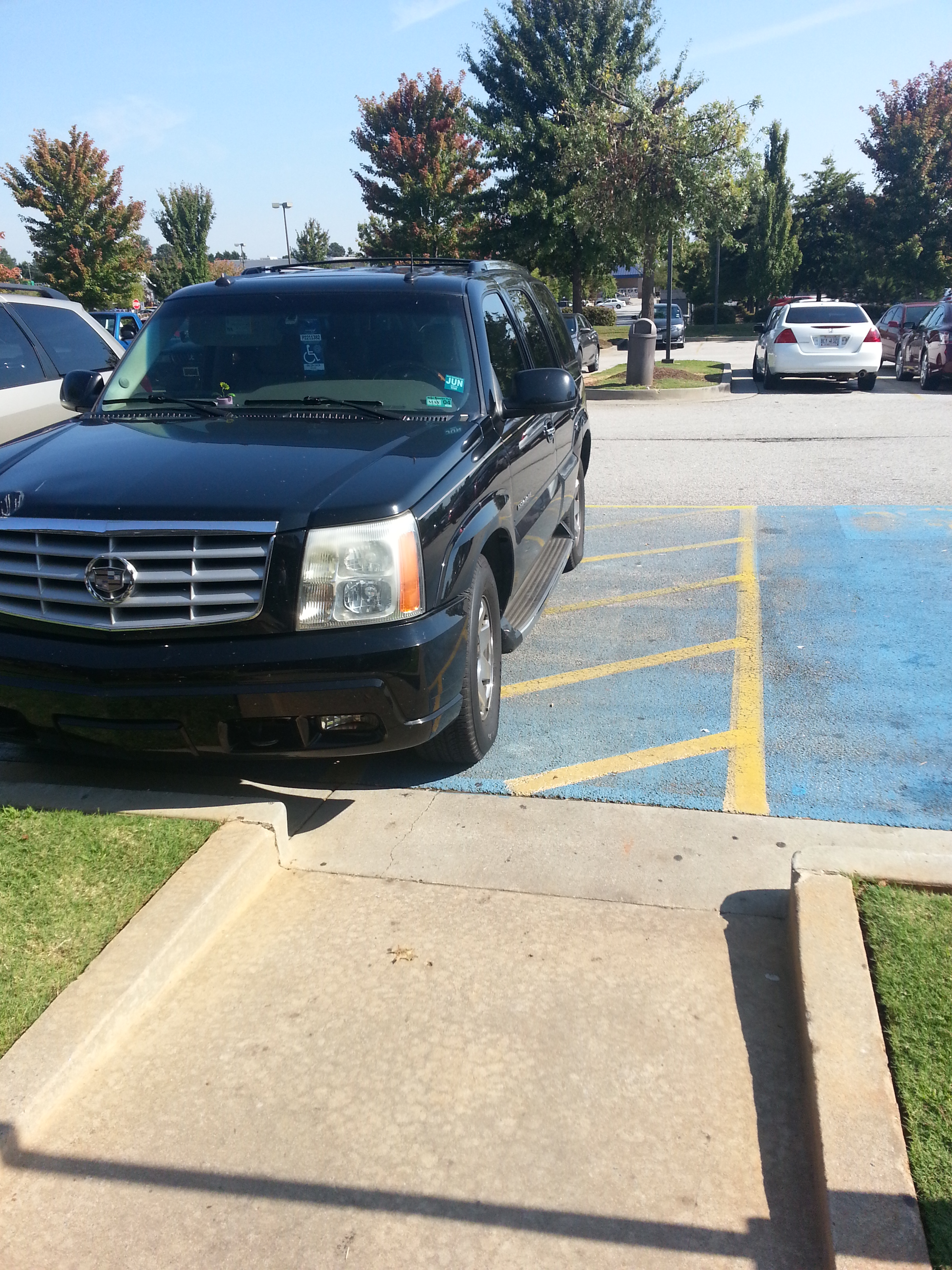
Today’s issue is that the handicap space we found was far from perfect because the car in the adjacent space was in my space. Both passenger side wheels were completely over their yellow line, in my space.  I tried to pull in but could not create enough space to be sure the ramp would deploy so we had to move on to look for another spot.  The car that caused the problem was also in a handicapped space but it was truly a car, not a van or any other type of vehicle that would be difficult to park.  I also looked on the driver’s side of the car and there was a huge space between the driver’s side of the car and the next vehicle.  I wasn’t calm enough to think about talking a photo to show you exactly what I am talking about.  However, I did have a similar situation on a different day and I took a photo of this one.  How Not to Park in a Handicap Space

I know what you are thinking, “well it was a handicap driver so maybe I am being too harsh on their driving skills”.  Perhaps but that wasn’t the case.  When we returned to the van after shopping, the driver was standing behind her car talking to a friend.  This was a woman much younger than we are and in apparent good health with no obvious handicap condition.  I observed her standing and talking to her friend without any aids for quite a few minutes before I left.  (This opens up a whole other can of worms but I will defer that discussion for a different Blog entry in the future.)

My educated opinion after careful observation is that this person was more than capable of parking her car within the lines. She was irresponsible and lazy in pulling in the way she did, causing problems for people who needed a full, van-accessible space.  It is the entitlement mentality that permeates our society and dictates the daily actions of so many.   A person with a handicap permit should understand the need for keeping handicap spaces as unimpeded as possible.  They should identify with this need more than the average person.  Unless, they are not really handicapped and shouldn’t have the permit in the first place.  But there I go again trying to launch into that other topic.

For now, I will just say this “If you park in a handicap space or adjacent to one, PARK BETWEEN THE LINES!!”

Other Obstacles

We have already discussed the obstacles to traveling with a wheelchair-bound individual that I call “showstoppers”.  A showstopper is something that completely prevents an action from taking place or requires such major modification that the original objective is not realized.  We were thinking about some of the other issues, not showstoppers, we have faced periodically and how we worked around them.  That led us to decide a Blog entry that deals with “others obstacles” would be appropriate.

The Americans with Disabilities Act (ADA) is now 25 years old.  The legislation along with the regulations written by the enforcement arm of the federal government have eliminated so many obstacles to wheelchair patients.  The ADA has also raised the societal consciousness about access for handicapped people immensely.  Still there is a strong need for those tasked with compliance to think more like a handicapped person when making decisions about implementation of accessibility. We contend that every business and government entity that must comply with the ADA should have one or more handicapped persons or caregivers on staff to give practical interpretation of design alternatives.  Most businesses could gain so much in customer loyalty by simply taking an attitude of “we will make it work for you” instead of hiding behind the more general regs of the ADA.  The “other obstacles” we will discuss frequently fall into this category.

Restaurants have not been a source of great stress in our travels but they are not perfect either. Have you ever stepped into a restaurant that has more booths than tables and the tables are all full? Cheryl does not leave her wheelchair at restaurants for reasons explained in earlier Blogs. Booths do not work for us. Or how about a certain pizza chain that has tall tables with bar stools and a lot of booths?  A wheelchair traveler can be forced to wait for seating while other patrons walk in and are immediately seated.

Another comment about restaurants is the size of their tables.  A small table generally causes the wheelchair person to be uncomfortable.  The reason is the designer of the table was not considering the size and footprint of the wheelchair even after a chair has been removed from the table.  We have sat at many tables that were not wide enough for Cheryl to get up to the table without her feet contacting someone else seated at the table.  The alternative is for her to sit farther away from the table than a person would normally do while eating.

Here’s one that most people would never even think about.  We have seen a number of places that have ramps, walkways, and bridges that allow for wheelchair access.  But then the provider chooses aesthetics over practicality when constructing the access way.  For example, instead of concrete or asphalt for a pathway, brick pavers are used.  I dare you to roll in a wheelchair on a path that is essentially cobblestone.  It will literally feel as if your tooth fillings will jump out of your mouth from the bouncing and jostling.  Now imagine how a person confined to that wheelchair who has some pain and sensitivity in their body feels on a washboard path.  Got the picture?  The only workaround I have for this problem is to scout the terrain before attempting to push the wheelchair.  At times, I have taken much longer routes with Cheryl and her chair to avoid “lovely” but dysfunctional paths.

A similar obstacle is the use of plush carpeting.  This doesn’t happen often but we have seen hotels with deep pile carpeting in the hallways or in the rooms.  I suppose that gives the customer the feel of a high end hotel but why is it necessary in wheelchair accessible areas?  The carpeted hallways is especially exasperating when the wheelchair accessible rooms are a long distance from the elevators.  Some type of carpet are easy for us to navigate, like berber or indoor-outdoor but the deep pile stuff is not.

Another version of the carpet obstacle is places that have tile or marble floors (which we like!) and their rugs.  Often a business will place heavy, deep pile rugs in the areas where the wheelchair must travel.  This is done for aesthetic value since there is obviously no practical value.  In fact, I have even seen people who are ambulatory trip over the rugs when they step from the tile/marble floor onto the rug.

Cruising

We have now been on five Caribbean cruises as a couple.  The first one was before Cheryl developed MS but the other four have been in the past 5 years.  Every cruise has been pleasant and enjoyable with minimal stress.  We feel that cruising is the most wheelchair friendly mode of vacationing.

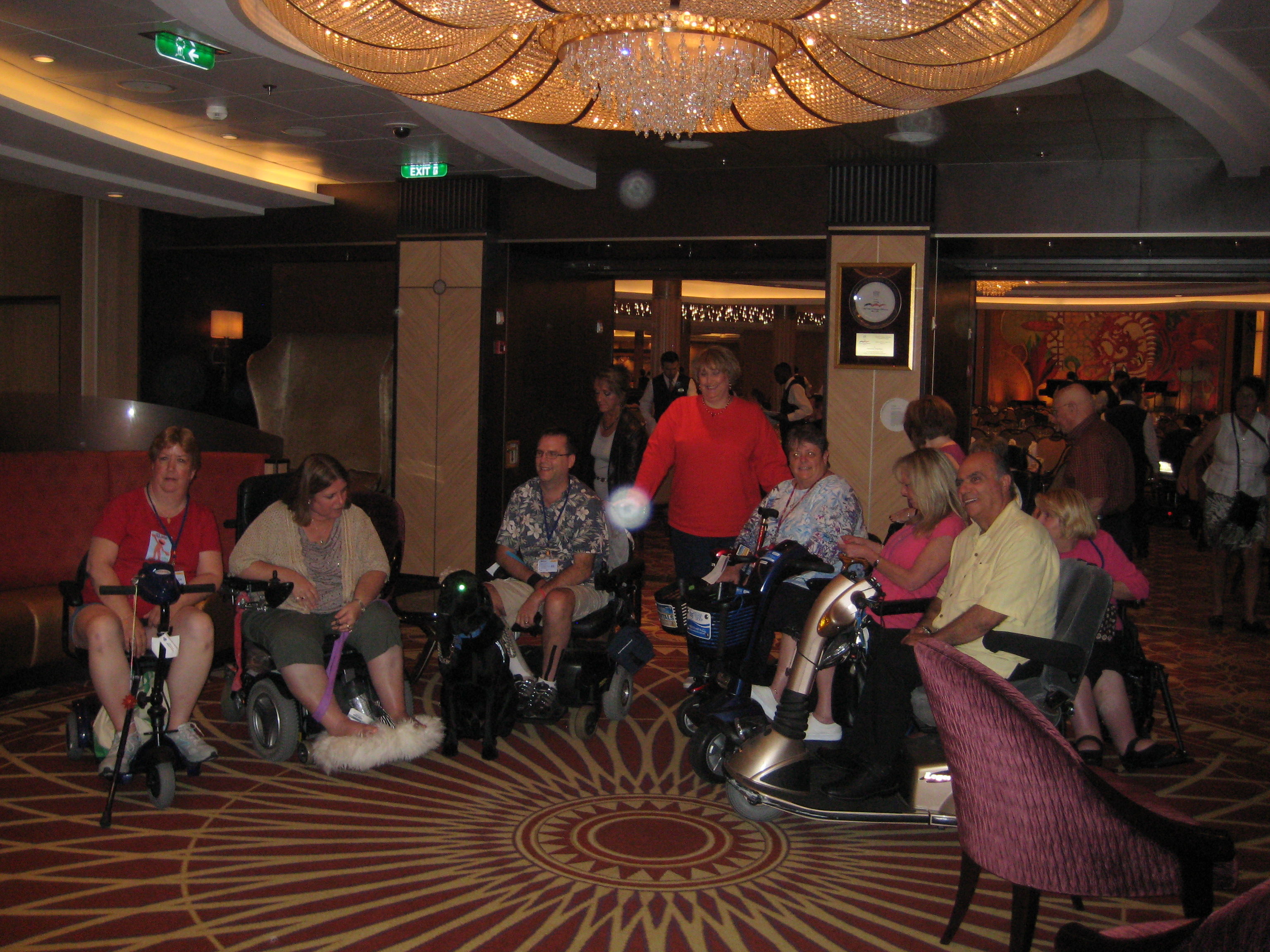
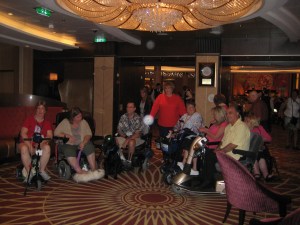
Royal Caribbean was our choice for a cruise line when we did the first one in the wheelchair. Actually it was really not our choice because we signed up to go with a group of MS patients and caregivers on a Royal Caribbean cruise.  The particular group we joined is based in Florida and is called MS Cruisers. Below is a photo of a small portion of the group on the Allure of the Seas in 2011.  We took a second cruise with MS Cruisers in 2014.  The group offers a chance to share with others dealing with MS in a setting that is very nice and comfortable.IMG_2957
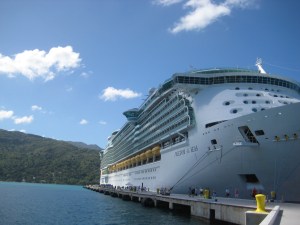
Once we experienced a Royal Caribbean vacation, there has been no desire to move to a different cruise line.  As with so many things in traveling with an MS patient, once we discovered the great service and accommodations offered by Royal Caribbean, we stuck with it.   We have our sixth cruise already booked for early 2016.IMG_3621
All our cruises have been to the Caribbean for two reasons.  First, we love the blue water, white sand beaches, and the people of the Caribbean.  Second, living in Atlanta and traveling only by van, Florida departure ports launching cruises to the Caribbean are the most accessible ones for us.  We have cruised to these islands in the past five years:  Cozumel, Jamaica, Coco Cay and Nassau in the Bahamas, Labadee (Haiti), St. Maartens, St. Thomas, and Grand Cayman.

Royal Caribbean gets an A+ rating from us because of the helpfulness of all their staff, especially for wheelchair bound passengers.  We have traveled on one of their largest ships from the Oasis class (Allure of the Seas) and on smaller ones.  We cruised on Freedom of the Seas (Freedom class) twice and found it very comfortable and plenty large.  Last year we cruised on Explorer of the Seas (the smaller Voyager class).  It was also large enough but wasn’t as well maintained as the previous ships.  We were told that it was heading for dry dock very soon which indicates it was time for refurbishment.  In the future, we will ask when a ship was last in dry dock before booking.

The food and drink on Royal Caribbean is stellar.  We have never received a bad meal in the dining room and have always found the Windjammer buffet for breakfast and lunch to be extremely good.  The food and drink staff is so helpful, accommodating, and friendly plus being entertaining at times.  Entertainment onboard is also excellent.  The musical shows in the theater are first class and we always enjoy the ice show.  There are movies and the casino plus lots of interesting people-watching.

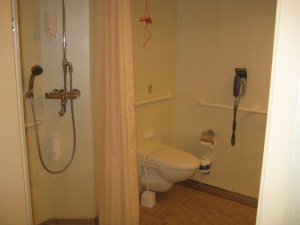
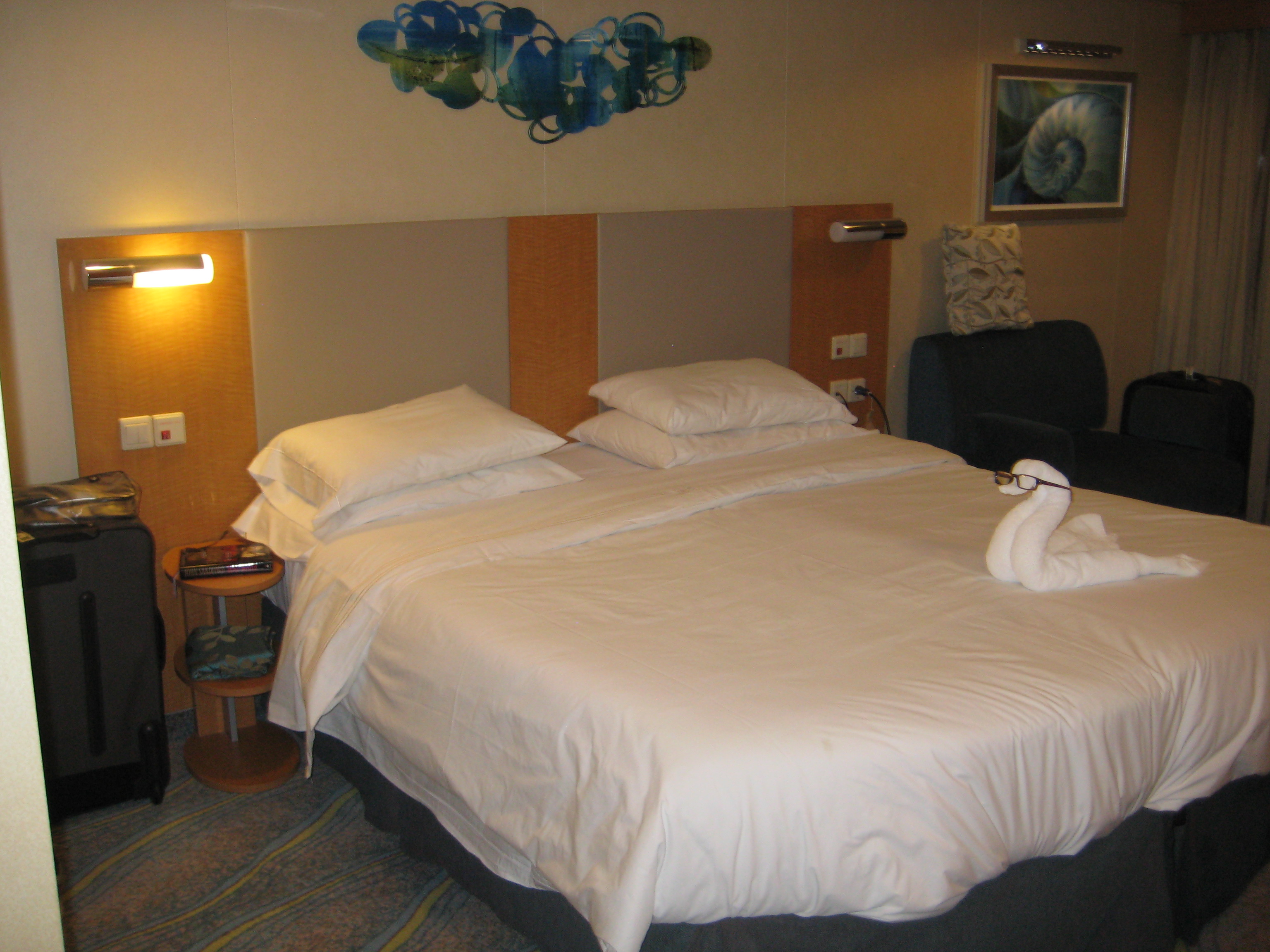
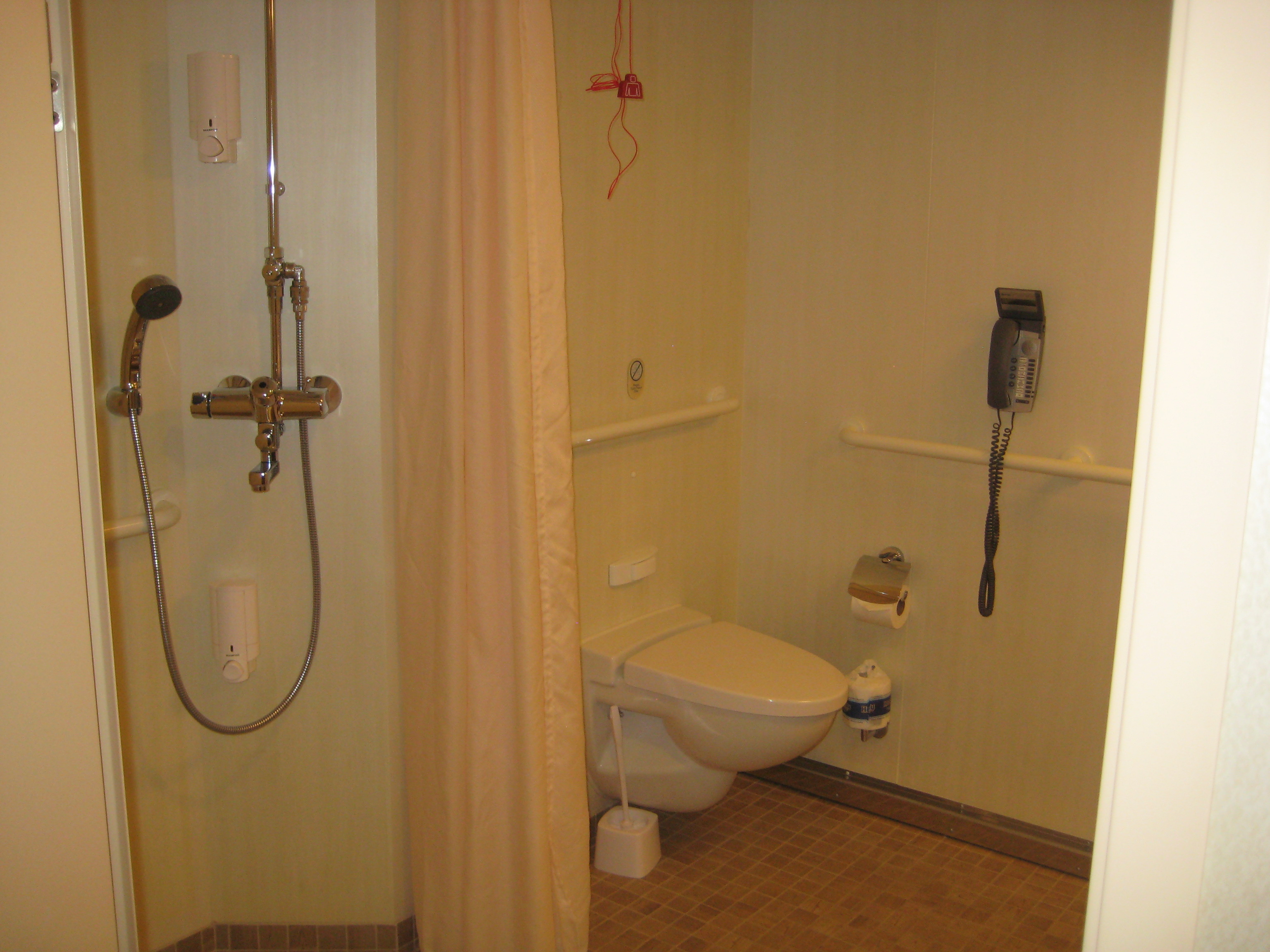
The wheelchair accessible rooms are truly that.  The sleeping area is comfortable and the bed accommodates our lift.  The bathroom is not large but is arranged strategically to provide ease of movement for the chair or the lift.  The stewards for our rooms have also been extremely proficient and accommodating.

IMG_2902 IMG_2900