I don’t particularly like the often used phrase, “the elephant in the room”, but that’s the most descriptive phrase I could come up with for this post. I have been holding off on this topic because it can be rather emotional to many folks. So let’s talk about how many government authorized handicap placards are out there in circulation.
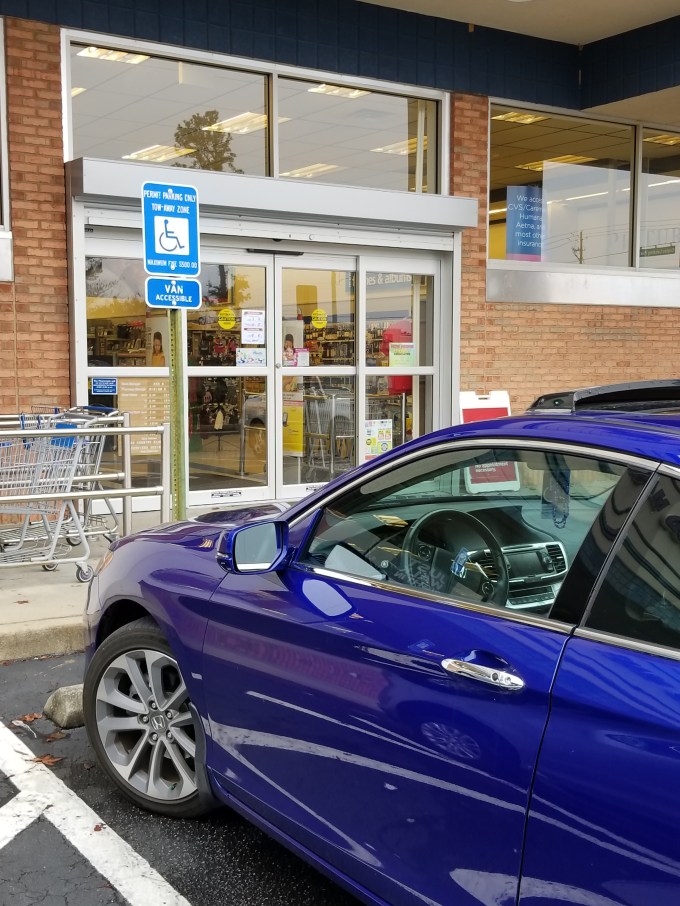
I’m sure healthy folks often feel that there are too many handicap spaces, forcing them to walk further to enter a business, church, school, airport, etc. I’m sure it is especially disconcerting to these folks when they walk by handicap spaces that are unoccupied. Let me assure you that from the perspective of one driving a handicap vehicle, there are never enough handicap spaces. We are especially limited because our van deploys the ramp out the passenger side. We must have a handicap space with the hashed lines on the right of the van. Otherwise, there is not sufficient space to deploy the ramp. If the only available space has the hashed lines on the driver side, it requires much maneuvering to turn the van and back in to allow the ramp to deploy. That doesn’t sound like a huge inconvenience but if you picture a van turning around in a parking row in a mall or shopping center, you will surely understand the challenge.
The ADA regulations require accessible spaces on a sliding scale starting at 1 for every 25 spaces up to 1 for every 100 spaces when the parking facility is larger. For example, a facility with 400 spaces must have 8 accessible parking spaces. Further, of these 8 accessible spaces, 2 must be van accessible with signage to indicate such. Those are federally mandated regulations so there is no room for negotiation or compromise. Our opinion is that the number of spaces is NOT the issue for us. It is the number of handicap permits issued. The ADA leaves the issuing of handicap permits to state and local government which probably means there are vastly different approaches around the country.
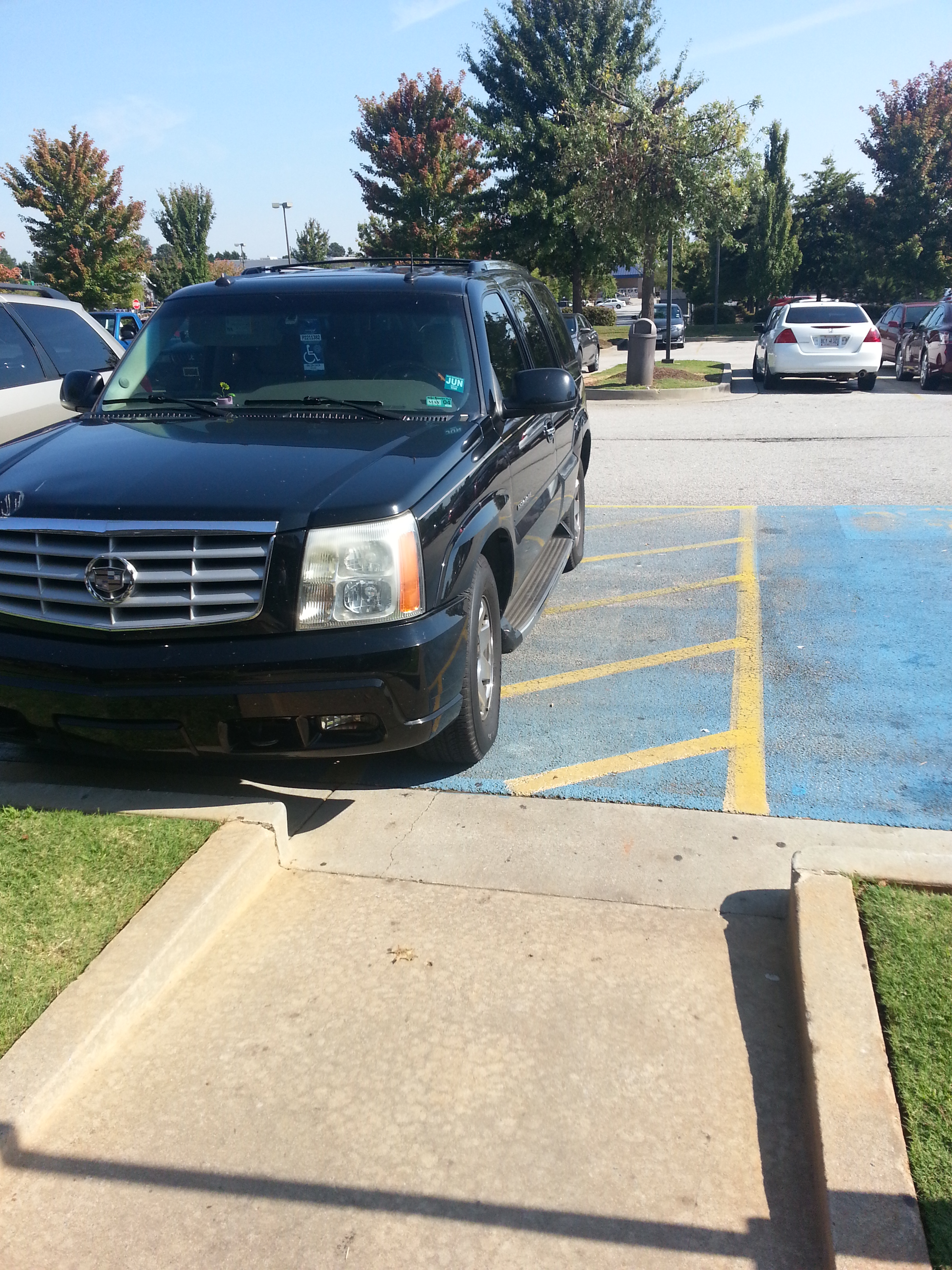
We are careful in observing people who use handicap parking spaces around us when we are out. About half the time, we observe people with no apparent disability displaying a handicap permit.
In Georgia, a person can qualify for a handicap parking permit under these conditions:
- can’t walk 200 feet without resting
- mobility severely disabled by arthritis, neurological, or orthopedic condition or complications of pregnancy
- severe lung disease
- hearing impaired
- blind or eyesight worse than 20/200.
The first three items lead me to believe that obvious physical distress would be observable from a person with any of those conditions. Things get quite a bit more subjective when I get to “hearing impaired” and eyesight measurement. Could these be the conditions that are creating the “loopholes” for healthy people to get permits?
Another loophole is people with non-permanent conditions that qualify in the list above. Pregnancy is not permanent but people recovering from major surgery or broken bones certainly need handicap access temporarily. Parking permits are issued with end dates if they are temporary. I believe it is very easy for a person to use a permit far beyond the end date because I have been told that local police are too busy to enforce the laws concerning handicap parking. If that is the case, then a recipient of a temporary parking permit can hang on to it and use it forever with no retribution.
We have more to say on this subject but you will have to return for another entry to read those comments.
 MS Road Warriors