
Tag Archives: MS Wheelchair bound

Other Obstacles

We have already discussed the obstacles to traveling with a wheelchair-bound individual that I call “showstoppers”.  A showstopper is something that completely prevents an action from taking place or requires such major modification that the original objective is not realized.  We were thinking about some of the other issues, not showstoppers, we have faced periodically and how we worked around them.  That led us to decide a Blog entry that deals with “others obstacles” would be appropriate.

The Americans with Disabilities Act (ADA) is now 25 years old.  The legislation along with the regulations written by the enforcement arm of the federal government have eliminated so many obstacles to wheelchair patients.  The ADA has also raised the societal consciousness about access for handicapped people immensely.  Still there is a strong need for those tasked with compliance to think more like a handicapped person when making decisions about implementation of accessibility. We contend that every business and government entity that must comply with the ADA should have one or more handicapped persons or caregivers on staff to give practical interpretation of design alternatives.  Most businesses could gain so much in customer loyalty by simply taking an attitude of “we will make it work for you” instead of hiding behind the more general regs of the ADA.  The “other obstacles” we will discuss frequently fall into this category.

Restaurants have not been a source of great stress in our travels but they are not perfect either. Have you ever stepped into a restaurant that has more booths than tables and the tables are all full? Cheryl does not leave her wheelchair at restaurants for reasons explained in earlier Blogs. Booths do not work for us. Or how about a certain pizza chain that has tall tables with bar stools and a lot of booths?  A wheelchair traveler can be forced to wait for seating while other patrons walk in and are immediately seated.

Another comment about restaurants is the size of their tables.  A small table generally causes the wheelchair person to be uncomfortable.  The reason is the designer of the table was not considering the size and footprint of the wheelchair even after a chair has been removed from the table.  We have sat at many tables that were not wide enough for Cheryl to get up to the table without her feet contacting someone else seated at the table.  The alternative is for her to sit farther away from the table than a person would normally do while eating.

Here’s one that most people would never even think about.  We have seen a number of places that have ramps, walkways, and bridges that allow for wheelchair access.  But then the provider chooses aesthetics over practicality when constructing the access way.  For example, instead of concrete or asphalt for a pathway, brick pavers are used.  I dare you to roll in a wheelchair on a path that is essentially cobblestone.  It will literally feel as if your tooth fillings will jump out of your mouth from the bouncing and jostling.  Now imagine how a person confined to that wheelchair who has some pain and sensitivity in their body feels on a washboard path.  Got the picture?  The only workaround I have for this problem is to scout the terrain before attempting to push the wheelchair.  At times, I have taken much longer routes with Cheryl and her chair to avoid “lovely” but dysfunctional paths.

A similar obstacle is the use of plush carpeting.  This doesn’t happen often but we have seen hotels with deep pile carpeting in the hallways or in the rooms.  I suppose that gives the customer the feel of a high end hotel but why is it necessary in wheelchair accessible areas?  The carpeted hallways is especially exasperating when the wheelchair accessible rooms are a long distance from the elevators.  Some type of carpet are easy for us to navigate, like berber or indoor-outdoor but the deep pile stuff is not.

Another version of the carpet obstacle is places that have tile or marble floors (which we like!) and their rugs.  Often a business will place heavy, deep pile rugs in the areas where the wheelchair must travel.  This is done for aesthetic value since there is obviously no practical value.  In fact, I have even seen people who are ambulatory trip over the rugs when they step from the tile/marble floor onto the rug.
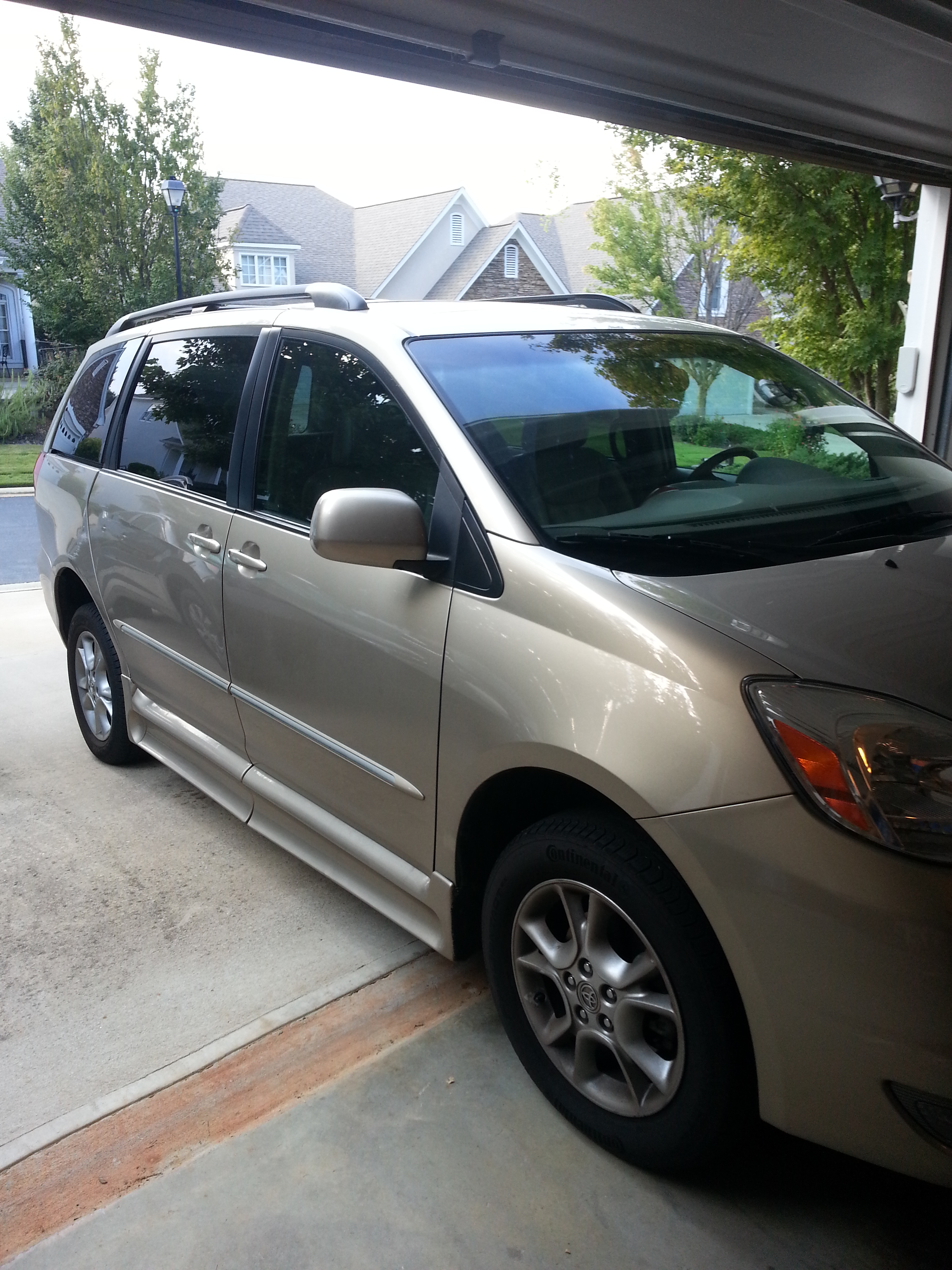
A Handicapped Vehicle

2005 Toyota Sienna Handicap Van

2005 Toyota Sienna Handicap Van

Within four years of Cheryl going into the wheelchair full time, we knew our days of traveling were numbered unless we purchased a van.  With both of our children living in different parts of the country with our precious grandchildren, something had to be done to get us on the road more.  We rented a van a couple of times to try out a modified van and found it very functional.  The company who rented to us in the Atlanta area also sells handicap vans so we negotiated with them to get one built to meet our needs.

The first requirement was a basic vehicle that would be extremely reliable because breakdowns on the highway with a handicapped person was a great fear.  Our preference was a Honda or Toyota for reliability but only the Toyota was capable of outfitting for a wheelchair at that time.  So in 2005, we purchased a Toyota Sienna.  We chose to have the middle row of seats removed to make room for the wheelchair.  We then chose a built-in ramp under the vehicle that is deployed to the side of the van on the passenger side.  That allows the wheelchair to be pushed directly up the ramp into the space prepared for it with no turning.  This decision was made because Cheryl didn’t like the feel or the view from the passenger seat area nor did she want the option to learn to drive herself. The passenger seat spot seemed better on the surface but in reality her head would have been just above the dashboard level.  That is because the floor of the van is lowered several inches when the outfitting is done and the wheelchair doesn’t sit as high as a regular car seat.

The next decision we made was possibly the most important of all.  We had an EZ Lock installed in the middle of the van in the area where the wheelchair is placed.  EZ Lock is a grappling mechanism bolted to the floor of the van.  The wheelchair is then outfitted with a large bolt placed to fit into the EZ Lock when the wheelchair is pushed over it.  The EZ Lock automatically grabs the bolt and locks the wheelchair in place.  This device allows KJ to push the wheelchair into the van and lock it into position without any bending, crawling, pulling of straps, etc.  When it is time to exit the van, there is a release button attached to the inside of the van wall that Cheryl presses. The wheelchair can then be pulled out with no effort.  Cheryl used the normal seatbelts in the van to secure herself in the wheelchair.  The seatbelts are outfitted with extenders to be able to reach around the wheelchair.

We have replaced wheelchairs more than once since purchasing the van with the EZ Lock.  On those occasions, the bolt on the bottom of the wheelchair is removed and attached to the new wheelchair.  We have also purchased a power chair to go along with the manual chair.  Both chairs have EZ Lock bolts on them so we can use either chair in the van.

When we purchased the van, it was a special order and we had to wait about 5 months to have it delivered.  The process was to go to a Toyota dealer and pick out the model we wanted.  We then went to the outfitter and ordered that model with the requested accessibility modifications.  (The business in the Southeast US that is the go-to provider of handicap vans is R&R Mobility.)  In our case the cost of the accessibility mods amounted to about 50% of the price of the base vehicle.  It is a sizable investment and one that must be done very carefully.  I’m not qualified to explain all the changes made to the basic van but I will mention the major ones I know about.

The floor of the van is cut out, lowered, and re-welded to allow more head room inside for a wheelchair and its occupant.  A hydraulic system is added to the van to allow the entire vehicle to lower itself about 10 inches before the wheelchair is put in or taken out.  This lowering allows the ramp to be at an incline that allows easier handling of the wheelchair.  Push buttons are installed on the dash and on the sidewall of the van to allow lowering of the van and deploying of the ramp with the touch of a button.   All of these changes have worked beautifully for us for 10 years!

Another note concerning maintenance.  Our van is approaching 100,000 miles but is still performing very well.  When there is a problem or the need for preventive maintenance, it is up to KJ to determine if it is something related to the base van or to the accessibility mods.  If it is the former, the van goes to a Toyota dealer.  If it is the latter, it returns to R&R.  Also when the van reached 8 years of age, KJ made the decision to begin doing large maintenance items prior to a failure on the highway.  The Toyota dealer provided good counseling on the different systems that might fail at the age of the van.  The work was spread over many months to spread the impact to our budget.  After 10 years, the van has yet to breakdown on a trip, either a short one or a long one.

With our wonderfully equipped, reliable van we have made driving trips from Atlanta to Denver, Houston, Dallas, Memphis, New Orleans, Charleston, Atlantic City, Fort Lauderdale, Biloxi, and the Smoky Mountains.  We travel only by driving the van and will continue that practice.  It was a sizable investment but has been worth every dollar.

A final note:  you may be wondering why we haven’t used air travel, especially for some of the more distant locations.  The answer is twofold.  First, the airlines are simply not equipped for a person in Cheryl’s condition.  They expect her to transfer from her chair to their narrow aisle chair then to the seat when boarding.  Of course, this process has to be reversed for deplaning.  When we tried that, it was very obvious that just doing all that transferring was extremely tiring and stressful for Cheryl.  It would also require KJ or someone else to basically lift her by hand.  Second, our normal daily routine requires equipment that we would not trust to airline baggage handlers.  I am talking about her wheelchair, the lift, and the limpidema device we carry for use on her legs.  Flying is a non-starter for this family.

Accessible Bathrooms

Some think the Americans with Disabilities Act (ADA) insures bathrooms in hotels will be wheelchair accessible.  That is oh so wrong!  Apparently hotels can install a grab bar or two in the vicinity of the toilet and are judged to be ADA-compliant.

In the early days we encountered many bathrooms of varying sizes and shapes that impeded accessibility for Cheryl.  Probably the worst example was a Holiday Inn Express in south Florida about 5 years ago.  We knew the hotel had been recently renovated and assumed that was a good thing.  When we arrived after a 10 hour drive, we discovered that the renovations were primarily in the lobby and front desk area plus some paint and carpet in some of the rooms. The footprint of the handicapped room was unchanged from the original construction of the hotel many years before. The bathroom was narrow with a tub with no access room around the toilet.  But it was ADA-compliant because 2 grab bars had been installed, one behind the toilet and one adjacent to the toilet.

Our complaint to hotel management fell on deaf ears and they had no alternative room to offer us. We were able to muddle through because it was only for one night before we boarded our cruise ship.

The lessons learned from this near disaster were:

  1. Insist on a handicapped room with a rollin shower.  This guarantees enough space around the toilet for accessibility.
  2. Never stay at a hotel that was constructed more than 10 years ago.
  3. Do not fall for the “newly renovated” label unless there are certainties that the handicapped rooms have been rebuilt.

Another point to emphasize with hotels is to ask if their wheelchair accessible rooms have raised toilets.  I’m not talking about the hard plastic, removable raised toilet seats but the taller commodes that are now used.  Commodes that are a minimum of 17 inches from the floor are typically called Comfort Height commodes.  19 inches is the current maximum height available for these commodes.  Anything less than 17 inches is considered a traditional commode.  Most traditional models are less than 17, usually 14 or 15 inches.  Now you may be saying that a couple of inches can’t make that much difference but that simply isn’t true when you are dealing with a handicapped person who doesn’t use a commode the way an able bodied person does.  I can speak from experience and say that a person who can not stand benefits greatly from a commode that is as high as possible.

Why Did We Create This Blog?

Welcome to our Blog.  We are not professional Bloggers so don’t expect professional writing and editing.  You can expect direct-from-the-heart comments and suggestions.

We are a family (Cheryl and KJ) who has dealt with mobility challenges for more than 2/3 of our married life, the result of Cheryl’s Multiple Sclerosis (MS).  We will be documenting our lessons learned in this Blog with the hope that it will assist other families facing similar challenges.  We look forward to your comments as you share your own experiences with us. Our desire is that through our sharing someone will learn a trick or understand a point that was not clear before.  Traveling with a spouse who is immobile is filled with challenges and many of them are not obvious until an issue has developed.  If we can help just one person avoid a difficult issue while traveling, it will be worth the investment of our time.

Meet Our Team

The principle in this team is the wife, Cheryl, who came down with MS in 1980 when her children were 10 and 7.  Her diagnosis was not confirmed until December, 1990 at the Mayo Clinic in Rochester, MN.  In those days, MS diagnosis was done by eliminating all other possibilities. As a result, diagnosis was imprecise and usually took several years.

Cheryl is a retired secretary and full time housewife.  The other member of this team is KJ, the husband.  He is a retired executive from a multi-national information technology company.  He is also the primary caregiver for Cheryl.

Cheryl has been unable to stand or walk since 2001, confined to a wheelchair since that time.  Her mobility was gradually reduced for the 10 years preceding 2001 so the total time we have dealt with some form of immobility dates back to 1991.